

Definition first, then interpretation.
What training volume means
Training volume is the total amount of weight you move in a given period, expressed in your preferred unit (kilograms or pounds). It\u2019s the simplest way to quantify how much work your muscles are doing.
LiftShift calculates volume as:
Volume = weight \u00d7 reps for each set, summed across all sets in the selected time window.
Example: if you bench press 100 kg for 3 sets of 8 reps, your bench press volume for that workout is 100 \u00d7 8 \u00d7 3 = 2,400 kg. LiftShift sums this across all exercises to give your total workout volume.
What changes volume
Volume changes whenever you adjust any of the three input variables:
- Weight: Adding 2.5 kg to your bench press increases volume.
- Reps: Doing 10 reps instead of 8 increases volume.
- Sets: Adding a fourth set increases volume.
- Exercise selection: Adding or removing exercises from your routine changes total volume.
- Workout frequency: Training more days per week increases weekly volume.
How to interpret volume trends
Volume trends are most useful when compared over time. LiftShift shows you:
- Session volume: How much work you did in a single workout.
- Weekly volume: Total work across all sessions in a rolling 7-day window.
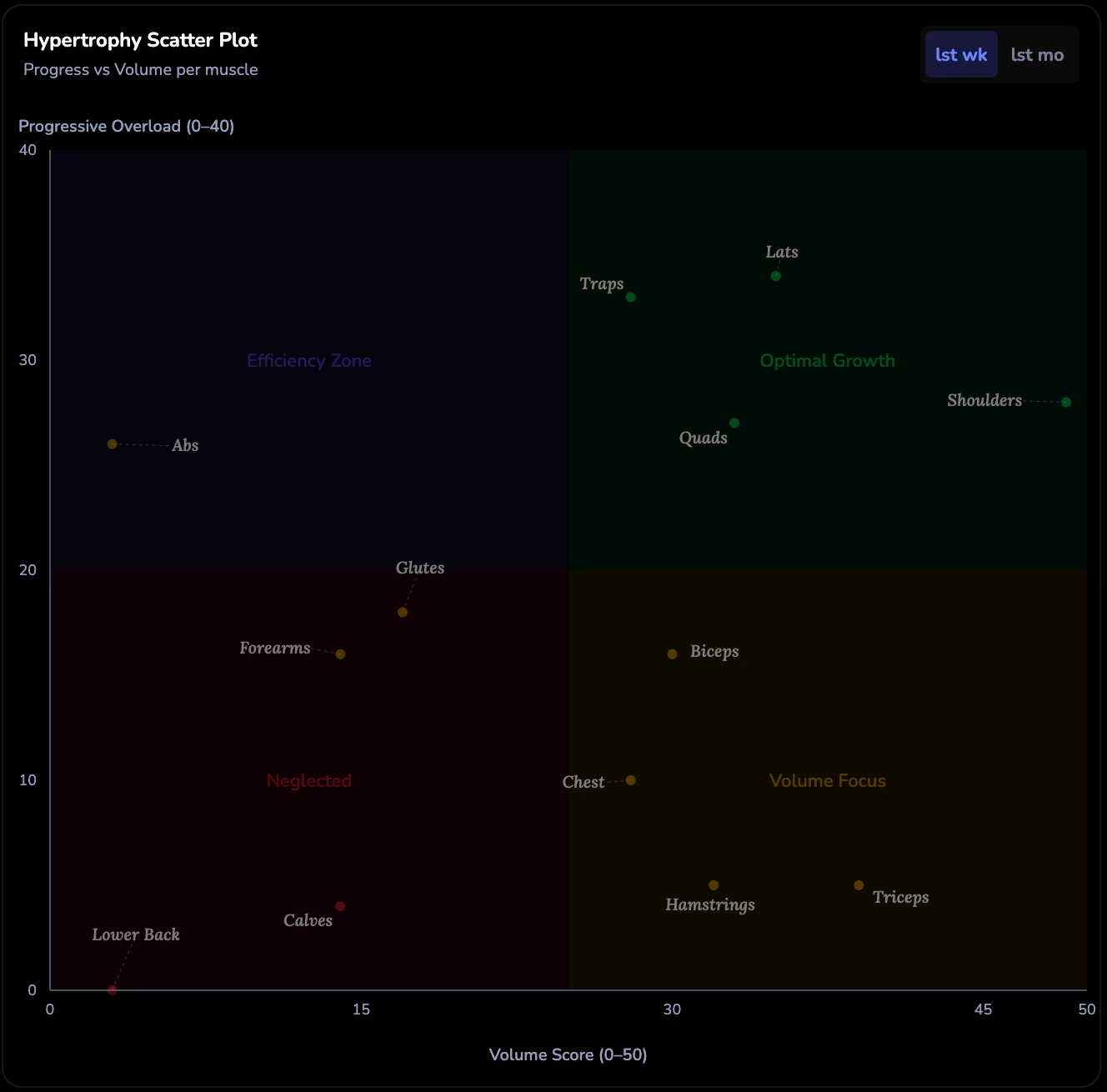
- Per-muscle volume: How volume is distributed across muscle groups (visible on the muscle heatmap).
- Rolling comparisons: This week vs. last week, this month vs. last month, so you can spot trends at a glance.
A steadily rising weekly volume often indicates progressive overload (you\u2019re doing more work over time). A sharp drop may be intentional (a deload week) or a sign of inconsistency. Look at volume alongside other metrics like PRs and 1RM estimates for a complete picture.
Volume vs. muscle growth
Higher volume is not always better. Training research points to a per-session volume ceiling beyond which additional sets provide diminishing returns and may increase fatigue without additional stimulus. LiftShift doesn\u2019t prescribe how much volume you should do. It shows you what you\u2019re actually doing so you can compare it against your own goals and reference research.
Volume zone scoring
LiftShift assigns each muscle group a volume zone based on your recent training:
- Maintenance: Volume is within the range that maintains current muscle size and strength. You\u2019re doing enough to hold ground but not enough to drive significant growth.
- Growth: Volume is in the range associated with hypertrophy stimulus. You\u2019re providing enough mechanical tension to signal adaptation.
- Overreaching: Volume is above the typical effective range. This can be productive in short blocks (overreaching phases) but sustained overreaching increases injury risk and may lead to systemic fatigue.
These zones are general guidelines based on exercise science literature, not personalised prescriptions. Individual response to volume varies significantly.
Caveats
- Volume counts all sets equally (a warm-up set of 10 rep counts the same as a working set to failure). LiftShift\u2019s set-type labels help distinguish these, but total volume is a blunt measurement.
- Volume doesn\u2019t account for proximity to failure, tempo, or range of motion. Two workouts with identical volume numbers can produce very different training effects.
- Bodyweight exercises are included in volume if you\u2019ve logged a weight. If you don\u2019t log bodyweight for pull-ups or dips, those exercises contribute zero volume, which undercounts your actual work.
- Volume alone is not a measure of workout quality. Use it as one data point among many.